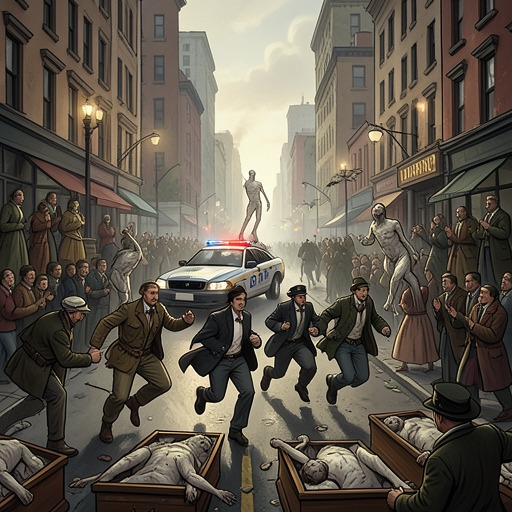
Two-month limit for revival
Handling the UndeadThe Two-month limit for revival is the apparent boundary discovered during the Stockholm crisis: the reported returns involved people who had been dead for no more than two months. It gave the emergency a measurable scope, but not a settled explanation. The evidence established a pattern, while leaving open whether the limit reflected a biological mechanism, the circumstances of particular bodies, or something not yet understood.
The First Evidence of a Boundary
At 23:50, Danderyd Hospital reported that two bodies had not returned to life. Their records showed that one person had been dead for ten weeks and the other for twelve; both corpses had also been treated repeatedly with formaldehyde while funeral arrangements were pending. The cases therefore differed from the reported awakenings in both the duration since death and the handling of the bodies. Further reports of non-awakenings followed, and officials drew a provisional conclusion: it appeared that only people dead for two months or less had returned.
The distinction was based on an emerging pattern, not a demonstrated cause. The two bodies beyond the apparent limit had undergone formaldehyde treatment, a detail that complicates any simple claim that time alone determined whether someone would awaken. The reports support the two-month cutoff as an observed rule of the crisis, but do not establish why it held or whether every body within that window would return.
Counting Those Within the Window
Once the period became a working boundary, officials could estimate the scale of the emergency. Correlating databases for the greater Stockholm area and counting people who had died during the preceding two months and remained unburied produced a total of exactly 1,042. The figure turned an uncanny event into an urgent administrative problem: a defined group of graves might need to be checked, and the number was large enough to require an organized response.
At 23:57, a delegation equipped with sound amplification and digging equipment was sent to Stockholm Woodland Cemetery to listen at the graves, with possible opening of the graves in view. The search reflected both the practical force and the uncertainty of the cutoff. Officials had a time range with which to identify potential cases, but they still had to establish what was happening in individual graves.
Biology, Death, and Legal Uncertainty
The apparent boundary unsettled the ordinary definition of death. One account describes death as the cessation of metabolism and proposes that the body may have the capacity to restart that process, while emphasizing that definitive research was not yet available. If metabolism could resume after death, familiar signs no longer offered a reliable way to declare someone dead; the account concludes that everyone might return. The two-month finding narrowed the observed pattern, but did not resolve that larger biological uncertainty.
The same uncertainty had legal and ethical consequences. A published philosophical debate noted that existing law treated a person declared deceased as outside ordinary judicial protection, apart from the peace of the grave, and questioned whether that protection applied to the returned dead. It also argued that the legal position might soon change and that, in the interim, researchers could conduct tests that later laws might prohibit. The debate set possible suffering against potential benefit to humanity, citing sixty-five people in Stockholm who had died without awakening over two days and approximately 300,000 deaths worldwide in the same period. The time limit thus did more than sort cases: it helped define who might be studied, protected, or still regarded as dead, before the basis for those distinctions was clear.